學術引用 Citation
黃孫權(2014)。無地之愛:在田野與社會性空間的藝術。展覽手冊,北京:紅磚美術館。Huang, Sun-Quan (2014). U-topophilia: Art in Field and Societal Space. Exhibition catalog, Beijing: Red Brick Art Museum.
展覽手冊頁面
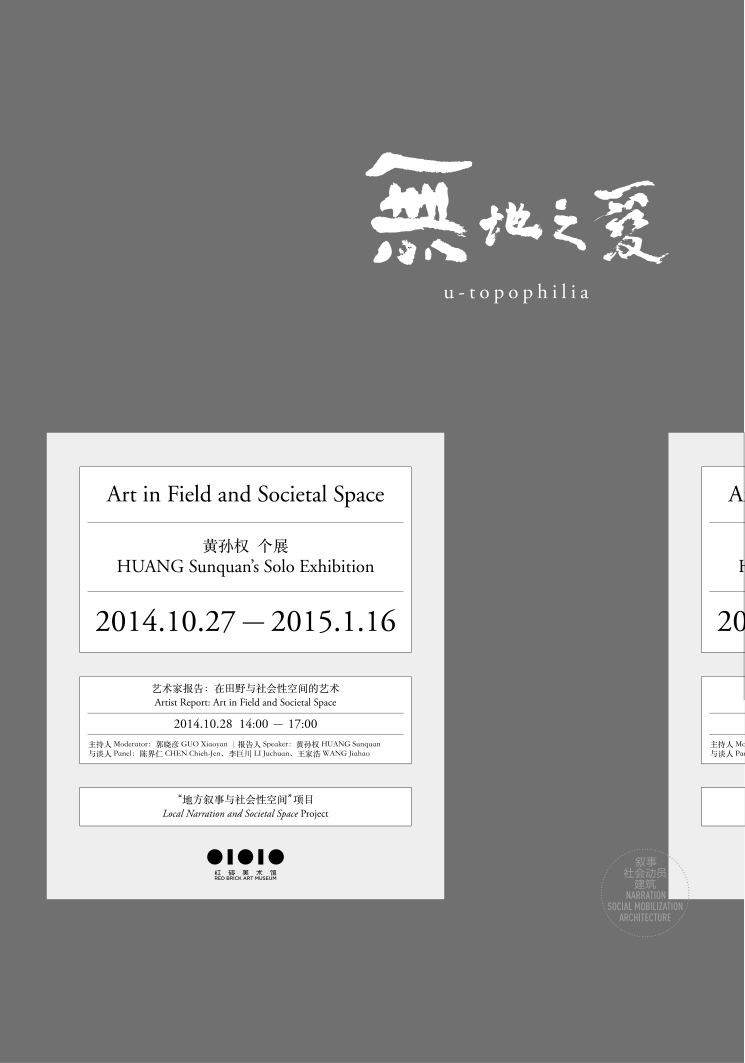
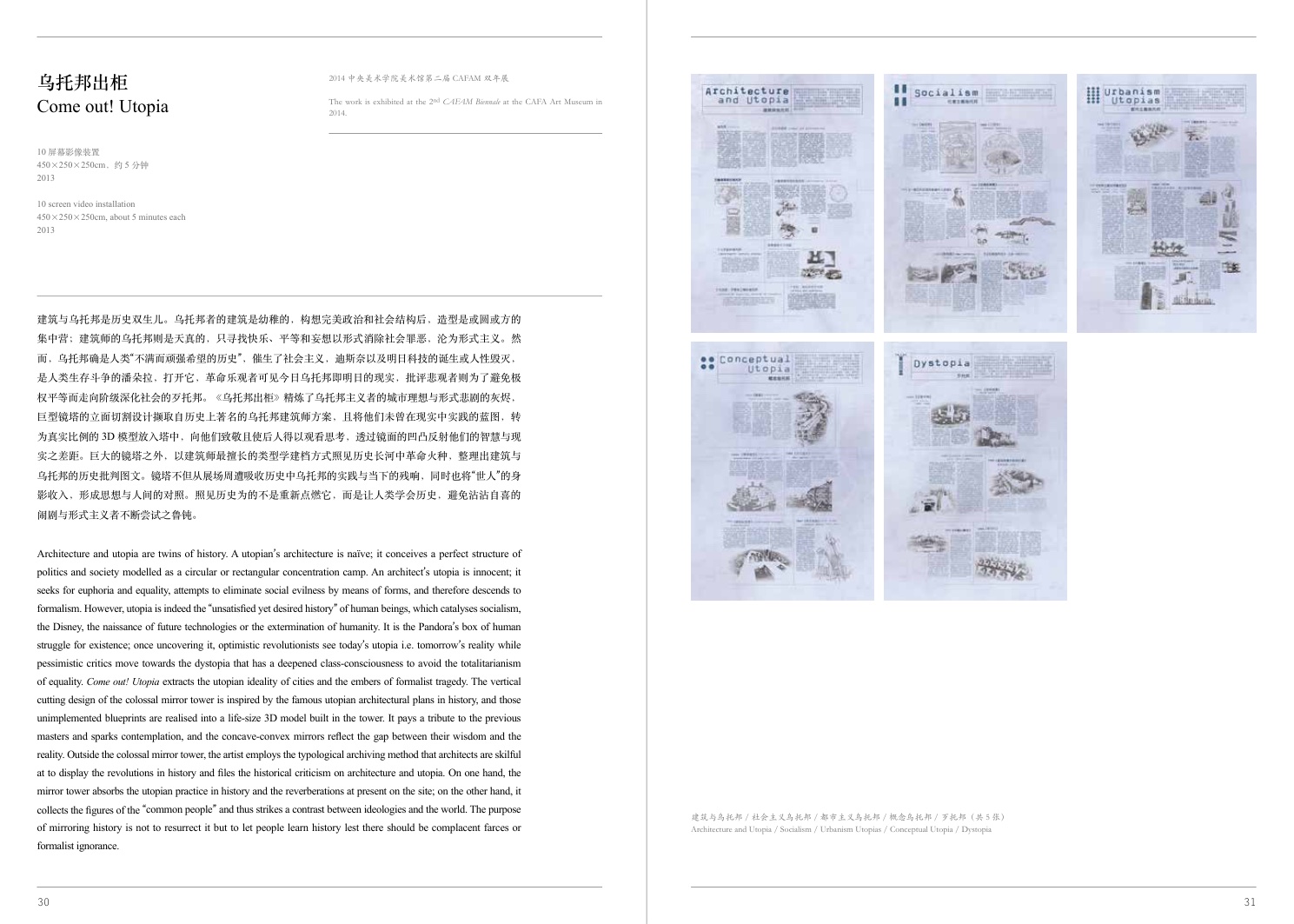
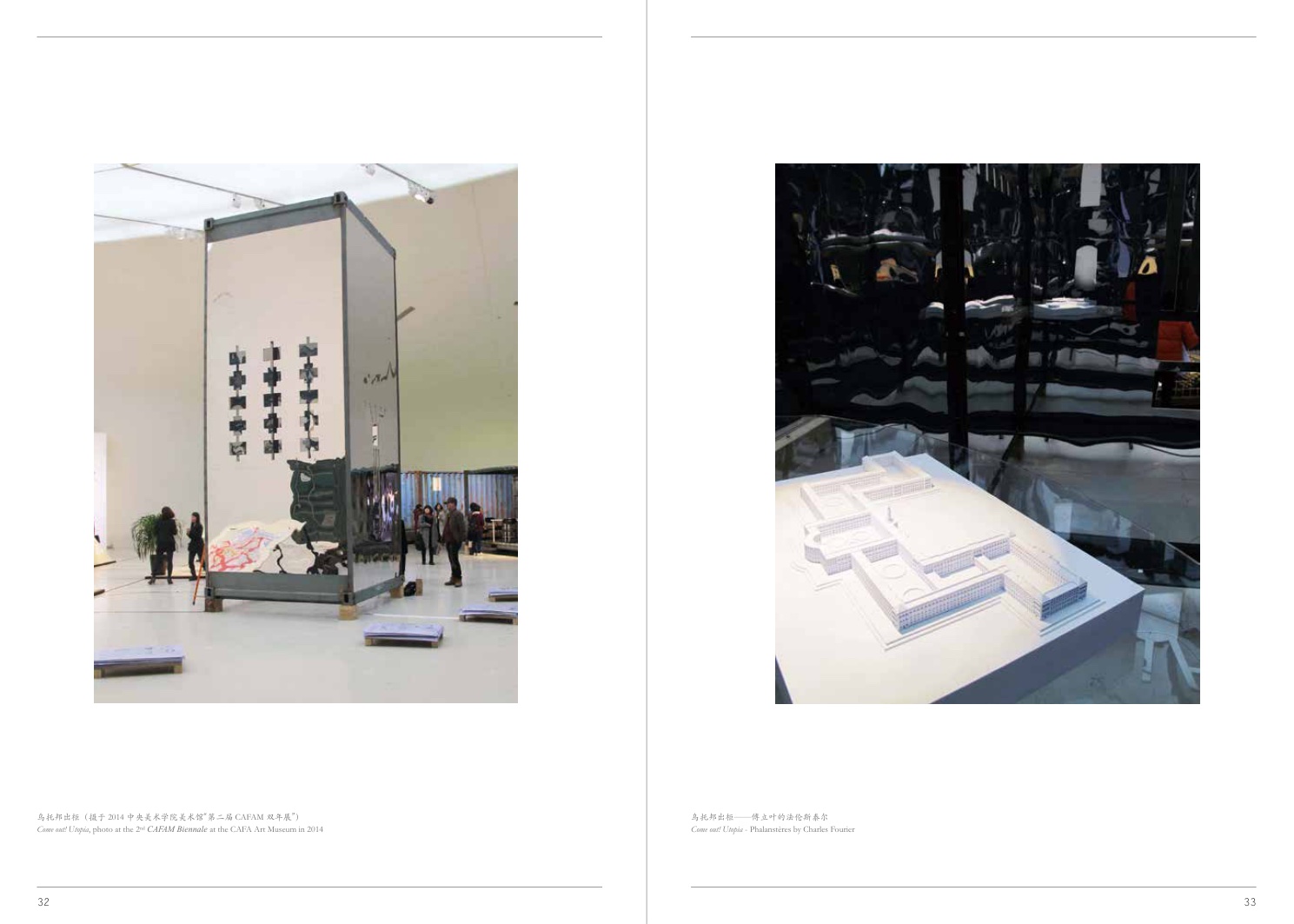
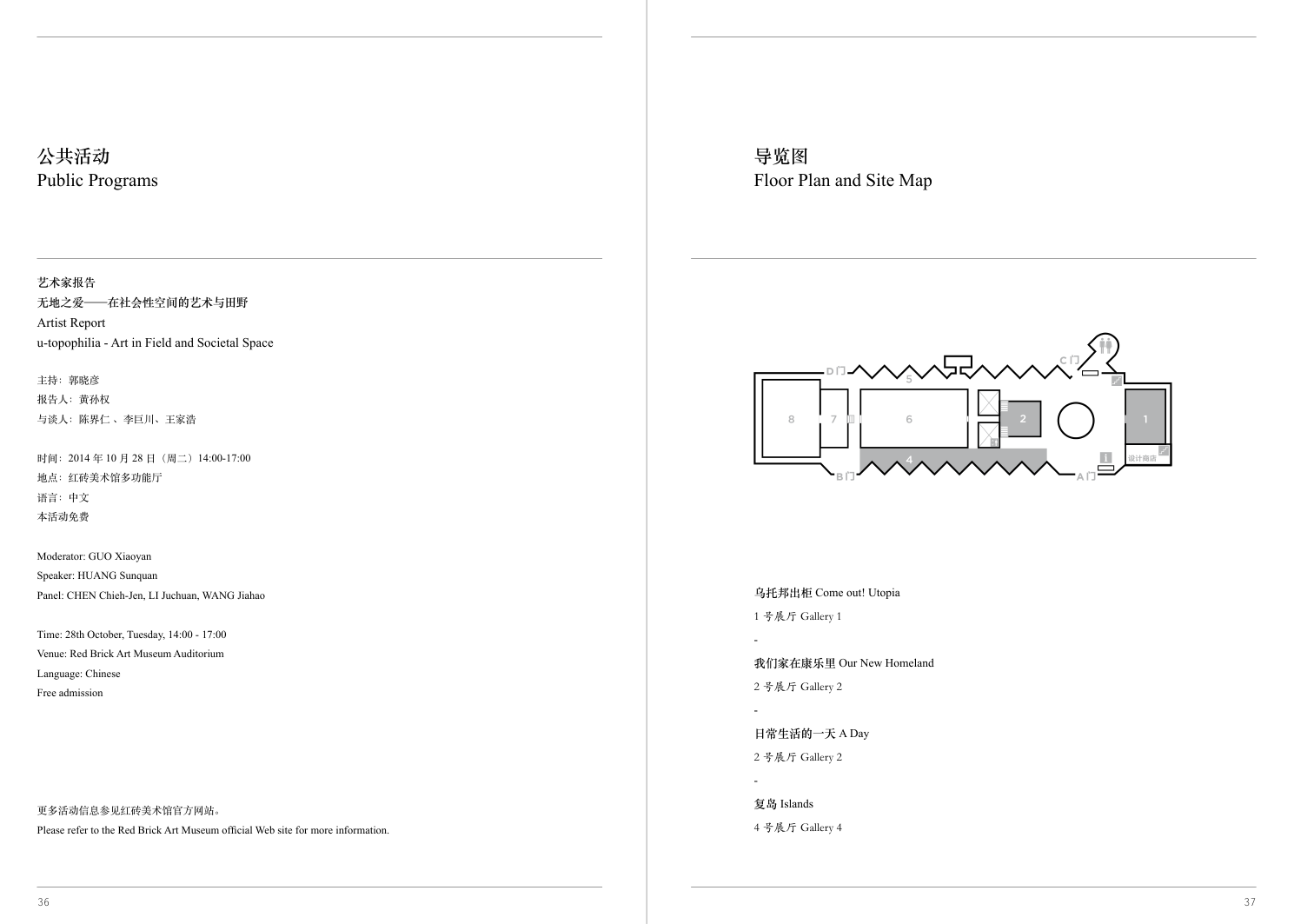

中文
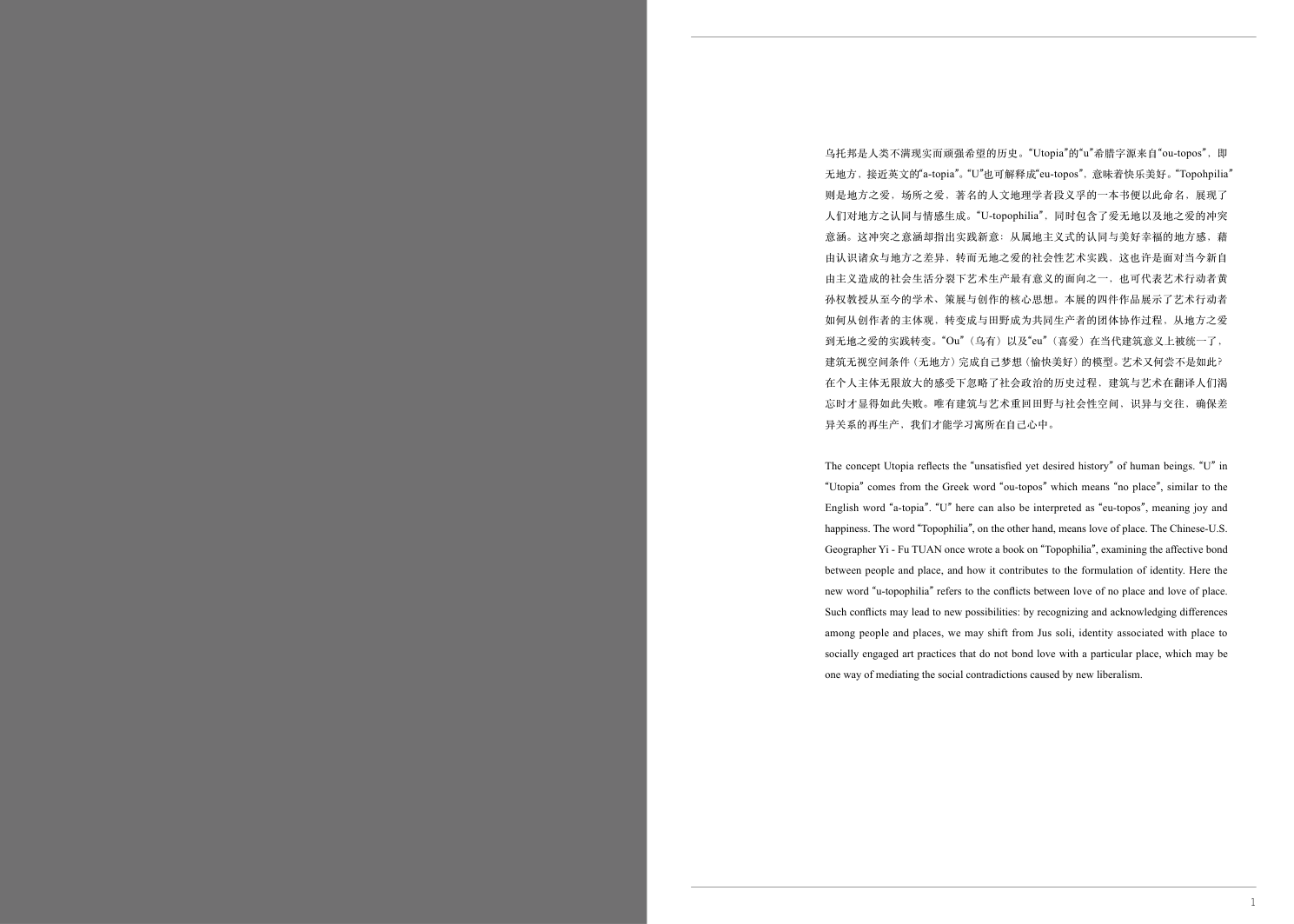
烏托邦是人類不滿現實而頑強希望的歷史。“Utopia”的“u”希臘字源來自“ou-topos”,即無地方,接近英文的“a-topia”。“U”也可解釋成“eu-topos”,意味着快樂美好。“Topohpilia”則是地方之愛,場所之愛,著名的人文地理學者段義孚的一本書便以此命名,展現了人們對地方之認同與情感生成。“U-topophilia”,同時包含了愛無地以及地之愛的衝突意涵。這衝突之意涵卻指出實踐新意:從屬地主義式的認同與美好幸福的地方感,藉由認識諸衆與地方之差異,轉而無地之愛的Societal Art實踐,這也許是面對當今新自由主義造成的社會生活分裂下藝術生產最有意義的面向之一,也可代表藝術行動者黃孫權教授從至今的學術、策展與創作的核心思想。本展的四件作品展示了藝術行動者如何從創作者的主體觀,轉變成與田野成為共同生產者的團體協作過程,從地方之愛到無地之愛的實踐轉變。“Ou”(烏有)以及“eu”(喜愛)在當代建築意義上被統一了,建築無視空間條件(無地方)完成自己夢想(愉快美好)的模型。藝術又何嘗不是如此?
在個人主體無限放大的感受下忽略了社會政治的歷史過程,建築與藝術在翻譯人們渴忘時才顯得如此失敗。唯有建築與藝術重回田野與社會性空間,識異與交往,確保差異關係的再生產,我們才能學習寓所在自己心中。
無地之愛——在田野與社會性空間的藝術
黃孫權
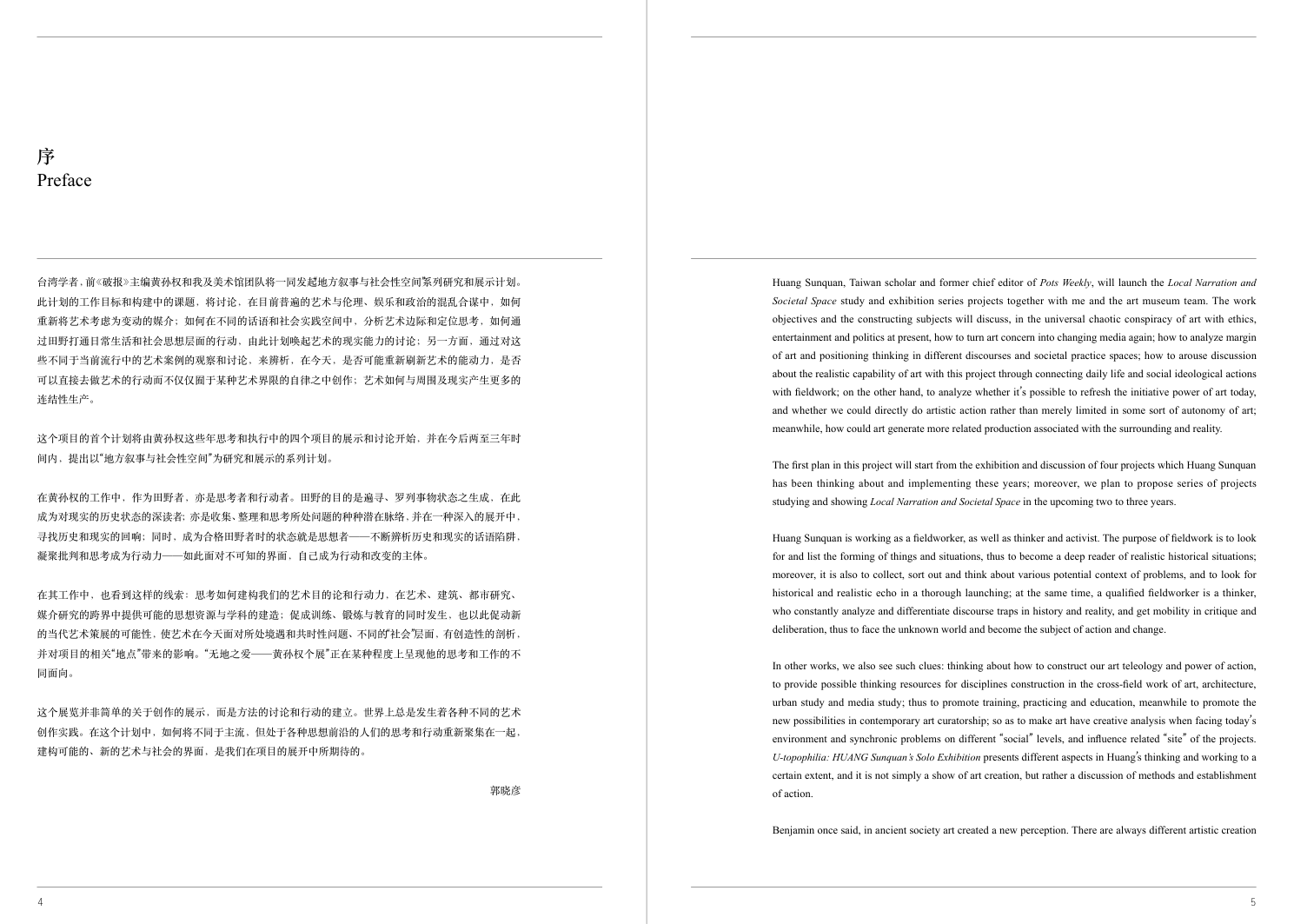
尤地之發—在田野與社會性空間的藝術此次紅磚美術館展出的內容,與其視為我近年實踐的部分作品,不如視作我對藝術與空間生產思考之方法論報告,視作陸續開展之“地方敘事與社會性空間”的首曲。亦是思考藝術為何田野,社會性空間中差異再生產的重要性,跨出所屬之地的情感構造,來面對當代藝術失去歷史計劃 (historical project) 之危機。
藝術家為何田野?
田野是我思考與實踐的場域,而非外於我生活空間的他方。如果建築與都市理論的背景使得我對田野深感興趣,那是由於田野並非歷史社會於空間寫下的痕跡而已,也是科學的客體與生活的主體交織之處。田野,一如地景,總是辯證的看與被看,是作為科學客觀的分析、調查的對象,也是生活於其中的人們之感受經驗。
進入田野意味着,我們學習與他人他方的差異,相互碰撞、矛盾、衝突、共感、連結,產生對雙方而言皆可改變現實,改變既定意義,有用的知識與行動。同時藉由進入現實一步一步修復社會關係,反抗景觀的與碎裂的,且到處都可以有的審美經驗。
當代藝術家進入田野顯然因為作品生產需要更多“異文化”、“異地”的素材,藝術家必得像蒐集材料畫筆顏料一樣的收集異於自己的人類文化,然後學會再現“他們”。自八零年代後,當代藝術逐漸接受由作者主體向與社會交遇,個體技術集體創作,挑戰歐洲中心主義以瞬間短暫感受為基準所建立的美學理論,強調美學感受可以是長期的,持續的,對話性的。以探尋、揭露公共議題的藝術計劃而非作品裝置的公共藝術,使得藝術家與社會交往變得必要。以上都涉及廣義的田野工作,更牽涉到參與、政治介入、合作/ 協作等行動。然而藝術家進入田野若未經過審慎反思,常淪為二流社會學家報告與庸俗民族誌者,作品是不精準觀察報告,專注於形式再現,田野資料既無檢驗標準也無品質,更無需對田野對象負責。藝術家不以改善現況為目的,總以“引起討論”作為已經有了反身性思考來推卸責任,導致藝術評論不敢論斷參與式藝術作品的好壞,因為這是“公衆參與”的結果,藝術家不再擔負美學與政治責任,社會參與和公共議題的揭酵就好似質量的保證。我們更應追問藝術家何田野?為何有權田野?藝術家的田野與社會學家、民族誌學者的田野有何不同?
今日當代藝術家進入田野的熱潮,是班雅明“作為生產者的作者”的藝術翻版(Benjamin,1986),“作力民族誌者的藝術家”(Artist as Ethnographer)(Foster,1995)。藝術自主論的布爾喬亞機構仍舊定義着藝術、觀衆、作品,藝術家卻越來越喜歡與文化和民族誌意義上的“他者”接近。藝術家假定了藝術轉換(transformation)的基地 (site)就是政治的基地,此基地落於他方(elsewhere)。於是乎一批准人類學家 (quasi-anthropologic)產生了,要與文化上的他者,被壓迫的後殖民國度之人,庶民和次文化合作。他者永遠是外於自己的,異質性 (alterity)是顛覆宰制性文化的主要因素。因此,藝術家若不能被視為是社會或文化上的他者,就無能接近此種轉換,相反地,就可以自動具有轉換能力。無論哪種模式,生產者模式,還是類民族誌模式,其實都是現實主義假設的錯誤,因為後殖民也好,無產階級也好,都不僅是意識形態的,而是社會地被壓迫、政治地製造以及物質地被生產出來的。
表現出認同差異和他者作為外在者 (outsider)的自動編碼,使得文化政治的邊緣性 (marginality)更為堅固而本質化了,使得我們自身內在的文化政治失去作用,而內在的文化政治更貼近於跨國資本主義的後殖民情境。如果作為生產者的作家站在無產階級的位置,也只是代理贊助者的角色,那準人類學家們儘管有着政治介入和逾越體制的決心,在特定的場所社區工作,也只不過希望這伴作品被贊助者記錄成是社會支援,經濟發展,公共關係⋯或者藝術”對於差異性的熱愛,對於他者或外在的政治投射都會減損此刻的政治,因為差異不保證顛覆與轉換,因為是投射,外部就不會是純粹的他者。當今學術報告開始流行情感性批評,懺悔式聲明,而準民族誌的作品在藝術市場流竄。十幾年前,人類學家對藝術家充滿妒意,藝術家是反身性典範,對差異敏感,對改變持開放態度,是有自覺的讀者。現在相反了,藝術家羨慕起人類學了,人類學是差異科學的主幹,以文化作為對象,有脈絡的實踐與他者的關係,可以裁定跨領域為何,人類學家的自我批判更是迷人。藝術機制不再僅是白牆內空間,也連結了其他社羣和對象,而藝術(家)被擴充進了文化領域(人類學家)。
儘管充滿危險爭議,但我認為田野有着更高的,不完全工具的目的。藝術家進入田野是尋求一種有效的行動方案,幫助田野者與田野對象創造可以解決問題改變現狀(政治)的知識。田野是一個劇場,藝術家面對不同地方與人羣文化,試着回應田野給出的問題。這意味着暫停自己熟悉的形式世界,擺脫自己的美學”,重新認識你自己與地方、與社羣/社區感覺結構的異同。毋寧說,藝術家做田野,是為了回答創作者的“謎題”(puzzle),謎題可以來自個人特殊的生活經驗、對常識的質疑、挑戰社會科學理論與主流意識認為理所當然的論點,豐富美學感受的思考,最終力量仍是藝術家的終極關懷。因為田野工作可能讓創作者驚訝,可以產生無法以原來立場解釋的新知識與美學關係。
社會性空間中的藝術生產我曾提出“Societal Art”的雛議「是回應藝術家為何要進入田野,以及藝術實踐的方法論(黃孫權,1. 在原本文章中,我用的是“sociality art”,借用法國社會學家米歐爾•馬費索利(MicheMaffcsoli)的概念。現代主義是一個社會系統(social system),是機械性的或政治經濟的結構,所以每一個個體(individual)是一種功能性的存在,社會的關係是一個契約的關係。後現代的社會組織方或跟現代主義的組織是不一樣的,是“socialin”(社會性)。社會性是一個複雜而有機的組合,也有機的出現在一般人口語中的“大衆”,或是知識分子的“諸衆”(mulitudes 或 masses)。這時候人是以一個角色(person) 出現,人作 一個角色不是力了滿足某種社會功能存在的個體,他是一個需妥扮演什麼角色的問題,(Maffiesoli,1996)。此可延仲至社會性空問(socictal space)中有關“社會”的概念,社會是人與人之間的關係,兩個英文字意義或有些微差異,但都重新賦予社會一詞的能亟2013)。Societal Art與社會藝術(social art) 不同,並非僅是參與或協作型藝術。Social 與 societal 兩者雖都指涉着社會,但social 在日常生活中多半意味着社會條件下的個人 (individual)反應,說某人的社會傾向,承受的社會壓力,都意味着個人要接受社會狀態的塑造,終就是個人要接受或者調整自己。Societal一詞中世紀出現,雖然使用較少,但學術界仍保留了其嚴格指涉了人與人之間的互動關係 (interpersonal)的特性,在中文語垸裏我翻成社會性。
Societal Art是立基真實的社會政治過程,重新喚起人與人的連結,並且將少數人的文化旨向變成社會承認的規範價值之一,並在社會性空間中創造新的藝術生產模式。藝術家與民衆一起工作,為的不是將他們當做再現的材料,而是與他們一起生產出“作品”,解決藝術家與民衆的共同問題並獲得知識上的進步。社會學家亞蘭-杜漢(Alain Touraine)強調行動者的主動性,強調“社會學式介入”(sociologicalintervention),主張社會行動的集體和研究工作共同產造知識,而研究者的介入主旨在於協同行動者從他們的處中脫離出來,以此能夠創造與以往左翼工運不同的社會性運動 (societal movement)。社會性運動不外乎個人的利益的集體抗爭(針對政治體系對社會需求的失能)以社會衝突的形式尋求文化價值的首肯與重建,這些文化旨向(投注)具體化為一個特定的社會形式的實踐,也是個人主體轉化成歷史主體(historical subject) 的過程(Touraine,2002),是一個社會性運動從反抗權力的抗爭邁向為更合理的社會發生過程。藝術工作者對文化行動的操作並不陌生,杜漢的提法正好提供了一個理論的視點,將藝術實踐與文化行動連結起來,從生產力層次而論,藝術與文化行動的實踐指向非常類似的,生產力並非全是物質也包含文化行動,“社會的所有面相,全部都是在文化旨向與價值之間,在社會自身生產的措施與那些再生產不平等和特權的措施之間被形塑出來的。”(Touraine,2002,p.185)
Societal Art一定發生在社會性空間中。空間瀰漫着社會關係,空間不是一個容器,而是造成社會關係持續再生產的原因和結果,每個社會都會生產其支持社會關係的空間(Lefebvre,1991)。關切人與人的連結所產生的動能,現實與歷史連結所產生的批判效果,社會空間結構化過程,目的乃是對世界進行政治批判與美學干預。對我來說,Societal Art就是理解社會政治過程,在推進/干預/改造實踐中的思考藝術生產之技術。
無地之愛當代藝術不再有歷史計劃(historical project),只有詮釋與更多的詮釋。在大型展覽中作品成為論述的證實物,展覽成為解釋不再成為事件。歷史中的藝術主義都有其歷史任務,如他們自我宣稱的那樣鬥爭出美學範式。無今藝術思潮沒有山頭要奔,於市場漂浮,抵抗成為形象之愛,革命變成形象,一切都可成為商品,審美(伴隨着各樣的感知分配理論)隨手可得。為了面對新自由主義的經濟福音與身體/ 道德養成,我們更應該從田野與社會性空間中,鍛造藝術實踐新的方法論,挖掘Societal Art的歷史任務,是積極在理解社會政治過程後,行動的政治實踐。
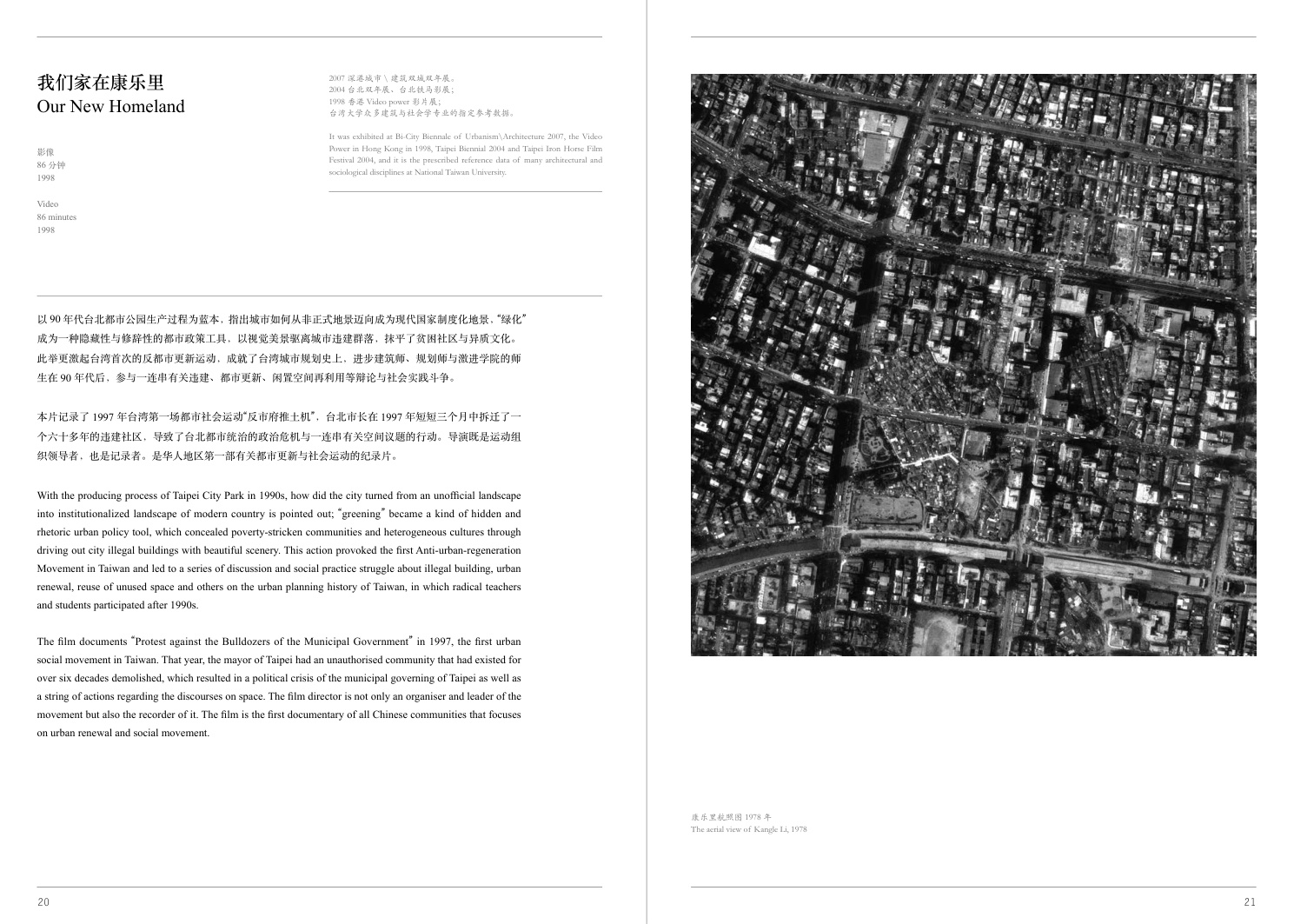
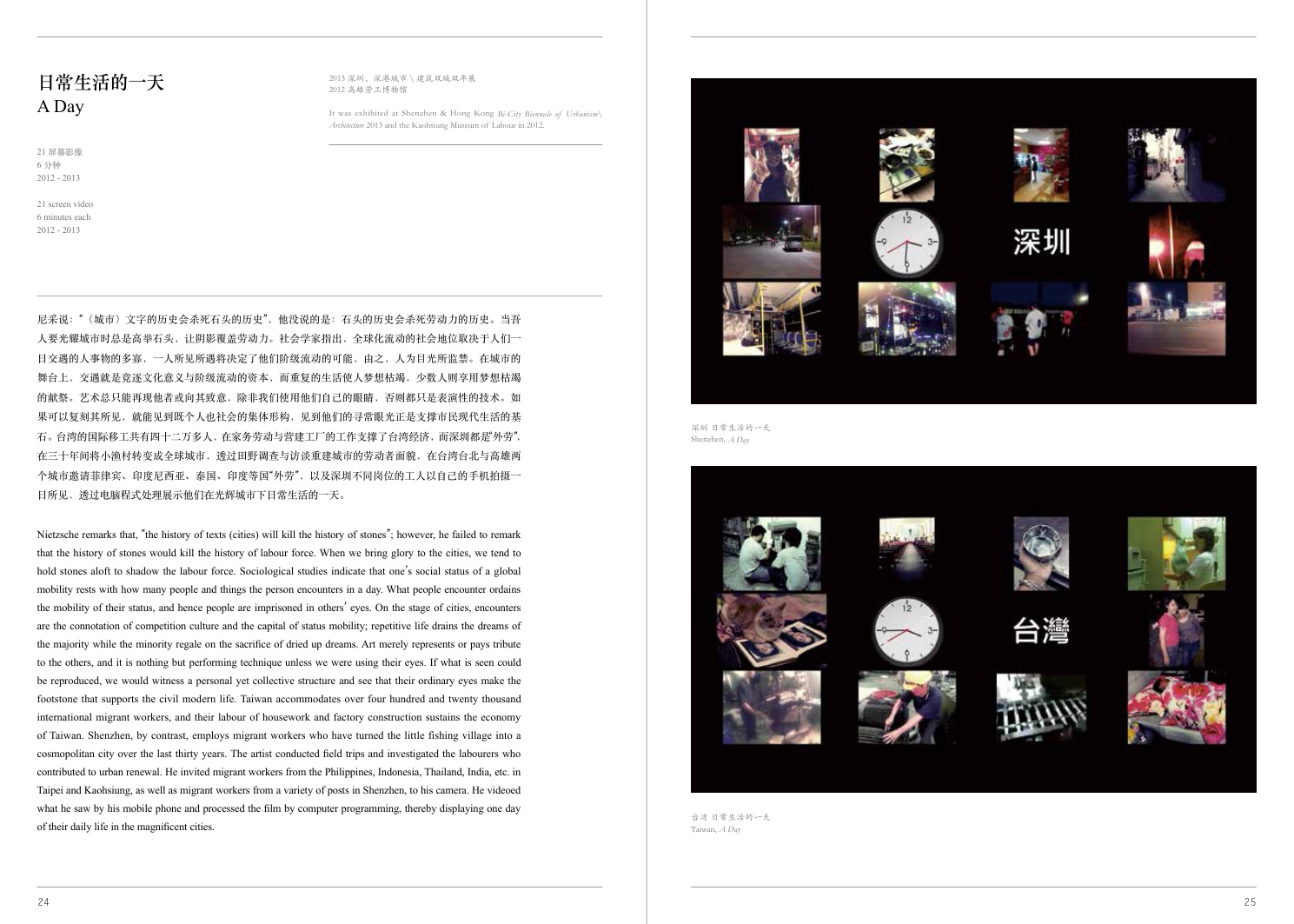
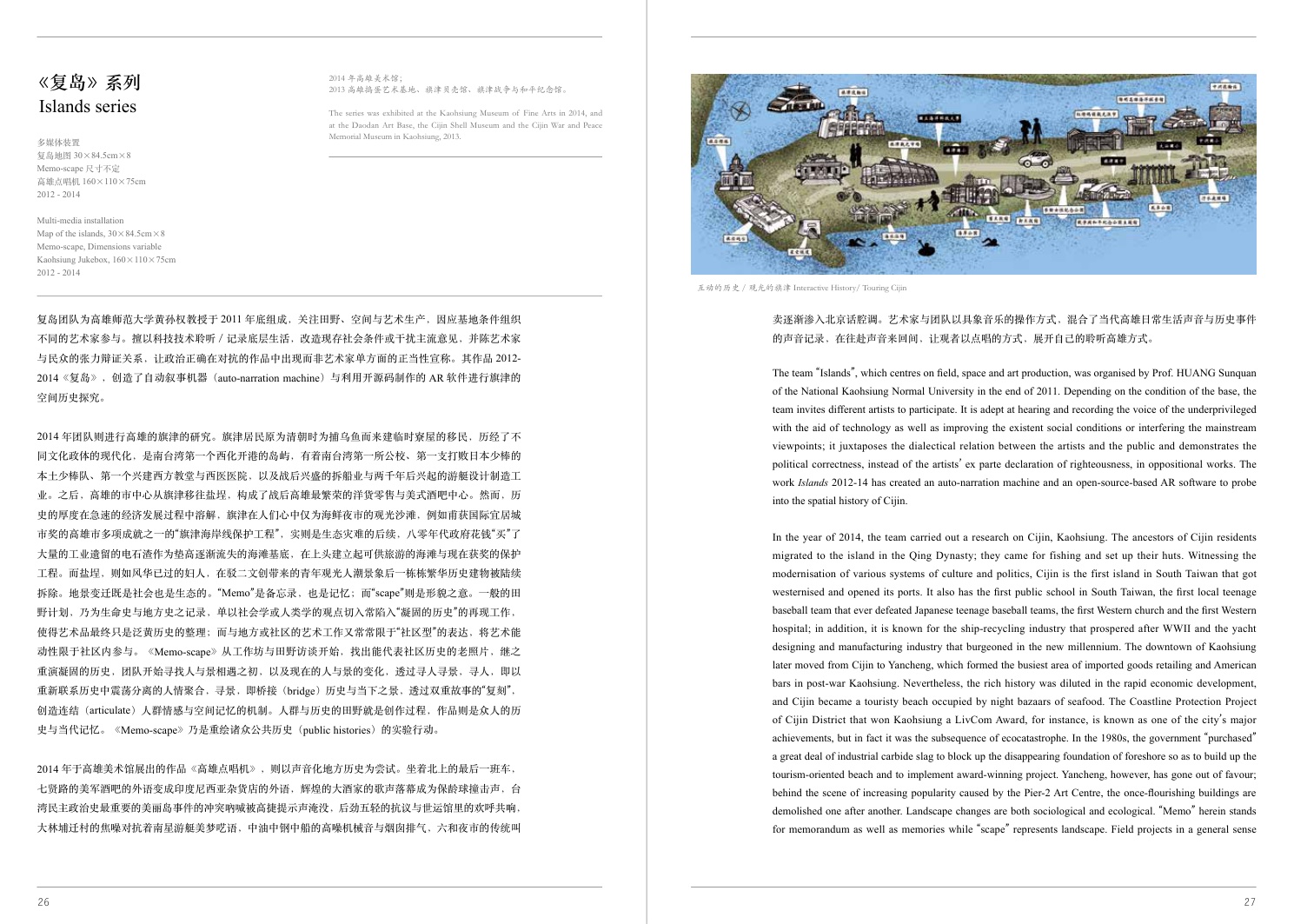
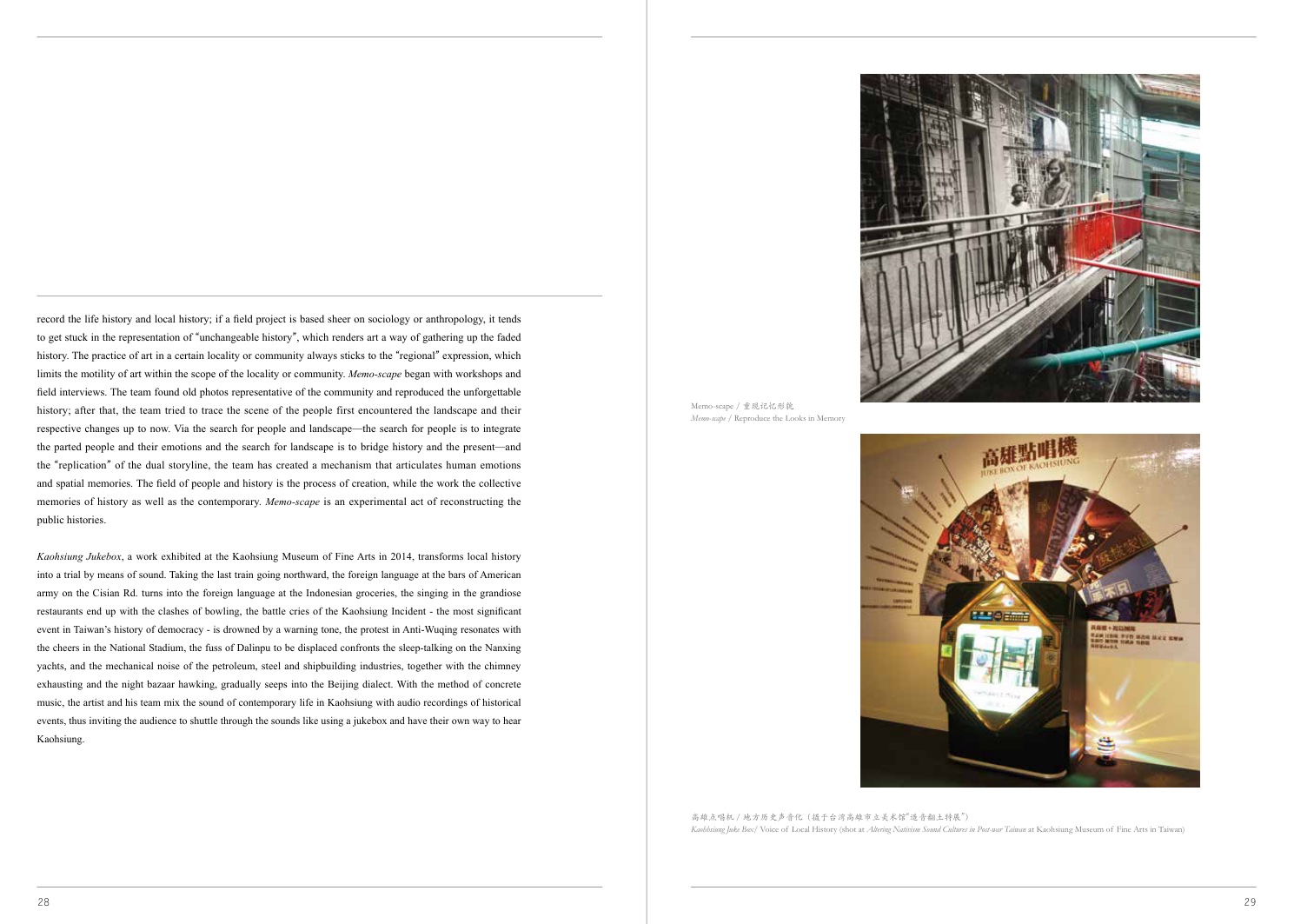
無論田野還是社會性空間,都隱含了地方,而地方則被多重社會力量所結構。這次的展出作品,是從地方出發又離開地方的,從主體出發又回到互我的過程,關切的都是空間生產。《我們家在康樂裏》是從主體實踐參與歷史主體的開展,這部華人首部的都市更新紀錄片,是我作為一個運動組織者自己拍攝製作,非一般“客觀中立”或“外於運動”的紀錄片,卻實際影響了臺灣15年來都市更新抗爭運動的經驗(這部片已成為臺灣大學各相關空間專業的必閱資料),以及相關影像呈現的模式。《出櫃》則針對建築成為展覽,以及建築作為資本先鋒的墮落,烏托邦建築與建築烏托邦如何從社會經濟計劃淪為造型操弄。《A Day》則是從嘗試離開作者所能觀看記錄的範圍,透過勞工於城市的工作生活,重繪城市與勞動面貌。《複島》系列的三個作品,則是以“集體”組織的方式和“地方居民”一同生產的作品。參與不是目的,也不是為了參與而參與,這再也不是為了要替誰代言,而是開始想象日常生活對於藝術的需要,想象尋常大衆對於藝術的可能需求。
鄉土認同,任何地方情感連帶 (affective bond),其根源都跟土地獨佔有關。是對所有權不質疑而發展的意識,我們如何想象去愛一個不屬於我、沒有我的家的地方,並發展出一個豐厚長遠的地方之愛?移民城市、落腳城市皆是人們尋求生活之地,而非對土地固着之愛。對土地之擁有與擁有的歷史會慢慢長成鄉土之愛,國家之愛,可是這恰好是財產製所確保的地方之愛。有時候,我們這種愛土地的感覺,常常會擴大到侵略別人的權利。於是,我們必須離開所屬。
Societal Art不是政治藝術,它非以宣言式、事件化處理政治美學或揭簬政治陰謀,也非以政治正確與否做作為好藝術的判斷;Societal Art不是參與藝術,它非以解除藝術獨特形式的倫理要務為目的,不斷強調民主表達(有時候恰恰相反),不是將空間、社區、羣體變成再現的客體,成為創作工具的磨練;Societal Art也不是十九世紀巴黎的社會藝術(social art)為弱勢發聲或教條地為社會主義宣稱那種資產階級救贖意識,不是讓中產階級看到貧民或異文化的展示,而是讓“他者”有生產/ 接近/使用藝術的權利,主張接近藝術的權利 (the right to art)。Societal Art乃是基於歷史診斷,基於對政治社會過程知識的理解,基於對日常生活的重新獲取,基於重新分配所有權,基於田野認識而產生的。Societal Art是連結的行動,是取回主體與經驗,是對各種社會動員劇場具有圖繪能力,它有很多種可能去想象,去生產,去實踐一種差異關係的再生產。Societal Art另立 (counter-)而非反對 (anit-),是社會的對抗而非政治的對抗,主張公共歷史就是公共藝術(public histories as public art),恢復少數人的歷史、記憶、習俗與權利,是重寫獵物的歷史而非獵人的成功。
無地之愛,U-topophilia,是從地方之愛出發,拋棄地方之束縛,離開屬地主義式的感情,認識差異,與他者交換視野與位置,尋得與整個世界的交流,如此才能寓所在自己的心中。
English
The concept Utopia refilects the “unsatisfied yet desired history” of human beings. “U" in “Utopia” comes from the Greek word “ou-topos” which means “no place", similar to the English word “a-topia”. “U” here can also be interpreted as “eu-topos”, meaning joy and happiness. The word "Topophilia", on the other hand, means love of place. The Chinese-U.S.
Geographer Yi-Fu TUAN once wrote a book on "Topophilia", examining the affective bond between people and place, and how it contributes to the formulation of identity. Here the new word "U-topophilia” refers to the conficts between love of no place and love of place.
Such conflicts may lead to new possibilities: by recognizing and acknowledging differences among people and places, we may shift from Jus soli, identity associated with place to socially engaged art practices that do not bond love with a particular place, which may be one way of mediating the social contradictions caused by new liberalism.
U-topophilia: Art in Field and Societal Space
HUANG Sunquan
U-topophilia - Arts in the Field and Social Spaces What's on show this time in the Red Brick Art Museum should rather be regarded as my report on the thinking methodology of art and space production, than as some artworks in my recent year practice; it should be regarded as a prelude to the gradually launching "local narration and social space”. Meanwhile, it's also a consideration about the reason why arts should be done as fieldwork, to think about the importance of difference reproduction in social space, in order to step out the emotional structure of where one belongs to, and face the crisis that contemporary art is losing historical project.
Why should artists do fieldwork? Field is where I think and practice, rather than other place out of my life space. If it is the architectural and urban theory backgrounds aroused my interest in field, the reason is only that field is not only the trace written down by historical society in space, but rather, it is also the interwoven point of scientific object with life subject. Field, just like landscape, has always been viewing or viewed dialectically; it is the object in scientific analysis and researeh, mneanwhile, it is also people's feeling and experience living in it. To eniter the field means we should learn diferences of others, to colide into each other, to have contradiction, conficts, common sense and connection, to produce useful knowledge and action that could change reality and existing meanings for both sides. At the same time, we should enter the reality to gradually restore social relationship, thus to resist those landscape like and fragmented aesthetic experiences.
Obviously, contemporary artists enter field for more alien-culture and other-place materials in art production; artists Should collect human culture different from their own just like collecting materials, painting brush and pigment, then they Learn to re-produce "the others”.After 1980s, contemporaty art gradually accepied the aesthetic theory that tuming from author-centered to social communicarion and personal skill but collective production, which is challenging Euro-centrism and established on tramsient sense; it emphasizes that aesthetic sense could be long-standing, constant and dialogie. Public arts which focus on art projects rather than installation researching and revealing public topics made it necessary that arists should communicate with the society. All the above are related to generalized fieldwork; moreover, they also involve actions like participation, political intervention and cooperation. However, if there is no strict and careful reflection before art entering field, then the resul ofien tums out to be second-rate Sociologists'report and vulgar ethographic work; it would be inaccurate observation report and focus on formal reproduction of which the field data would be of neither inspection standards nor quality; let alone being responsible for fieldwork objects. Artists do not pursue the goal of improving the situation but rather shirk responsibility through taking “arousing discussion" as reflection, so that art critics dare not judge the artwork; because it is a result of "public participation", artists no longer be responsible for aesthetics and politics, as if social participation and revealing public topics had assured its quality. Therefore it is more necessary for us to question why artists should do field work? Why do they have the right to do this? What's the difference between fieldworks of artists and that of sociologists and ethnographer? Today, there is a great fervor among contemporary artists in fieldwork, which is an artistic version of Benjamin (1986)'s “author as producer”, namely “artist as ethnographer” (Foster, 1995). Bourgeois institutions of art autonomist are still defining art, audience and artwork, while artists are growing fonder of getting closer to the "Others' in a cultural and ethnographic sense. The artists assumed that the site for artistic transformation is the one for politics, which locates at clsewhere. So that a batch of quasi-anthropologists appeared, they want to cooperate with cultural others, oppressed peoples from post-colonial countries, common people and subculture.
Other is always other than self; alterity is the main factor that subverts dominating culture. Therefore, if artists canot be regarded as social or cultural others, they can never get close tO this transformation: but on the contrary, they could automatically have the capability of transformation. All modes, of producer or ethnographer, are actually mistakes assumed in realism; as both post-colonial and Proletariat are not only ideological, burt also oppressed socially, made politically and produced materially.
Automatic coding showing identity gap and other as outsider, bas solidified the marginality of cultural politics and made it essential, meanwhile, it made the interal cultural politics of us get out of action and get closer to a transnational capitalistic post-colonial context. if the author as a producer stands in the position of Proletariat, he is no more than playing a role of acting sponsor; then although quasi-anthropologists have the determination of political interference and transcend system, while working in special site, the community, they merely hope that this piece of “artwork” could be recorded by sponsors as social support, economic development. public relationship:or'ants'.Love for differences, tor others or for extemal political projecion will deerease the politics at this moment, as diferences cannot promise subversion and transformation; because projection will imply that the exteral one will not be a pure other. At present, emotional critique and confessional statement begin to be opular in academic reports, while quasi- ethnographic artworks overwhelmed the art market. Dozen years ag nithropologists were full of jealousy towards artists, who were models of reflexivity and were sensitive abo lifferences, and they were self-conscious readers open to reform. Yet now if's different, artists begin to admir anthropologists; anthropology became the main force in the study of difference with culture as its objeets; the have contextual practice and relationship of others, they could define what is cross-border and their self-criticism are more attractive. Artistic system is no longer merely internal space inside white walls, but rather, it connects other communities and objects, while art (-ist) has been expanded into cultural fields (anthropologist).
Although dangerous and controversial, yet I believe that fieldwork has higher purpose that is more than a tool.
The artist is looking for an effective action plan through entering field, to help fieldworkers as well as fieldwork objects in knowledge for solving problems and changing present situation (politics). Field is a theatre; the artist is trying to respond to the questions proposed by field when facing different places and mass culture.
This means to take a pause in your familiar formal world, to get rid of your “aesthetics', to re-recognize the differences and similarities between you and the local as well as the community. Rather, the artist is trying to reply the puzzle of creator through doing fieldwork; this puzzle can be special personal life experiences, doubting about common sense, opinions challenging the social scientific theory and the taken for granted mainstream ideology and reflection that enriches aesthetic feelings, whereas the ultimate strength is still artists ultimate concern. Fieldworkers might surprise creators as they could produce new knowledge and aesthetic relationship that cannot be explained with the original stance.
Artistic Production in Societal Space Responding to the question why artists should do fieldwork and the methodology of artistic practice, I had once proposed the suggestion of "sociality art” '(Huang Sunquan, 2013). Societal art is different from social art, it is not just participatory or coliaborative art. Although “social” and “socictal' bouth refer to society, “sociar” mostly means individual reaction under social conditions in daily life; while talking about social tendency or social pressure of someone, it means that the individual should accept the shaping of social condition and should finally accept or adjust oneself. Societal is a word appeared in the Middle Ages; though rarely used, yet its particularity that strictly refers to the interpersonal relationship has been kept in the academic circles ;in Chinese context, I translate it into “she hui xing".
Sociality art is social political process based on reality; it could re-call connections between peoples and tum cultures of the minority into one of the normative values acknowledged by society, meanwhile, create new artistic production mode in societal space. Artists work together with the masses in order to produce “artwork” together with them, rather than taking them as the material of reproduction; they are solving common problems 1. In the original article, I used "sociality art", which is a concept of the French sociologist Michel Matfesoli. Modcrnism is a social svstem, a mcchanical or political cconomics structurc; thcrctorc cach indivdual 1s a tunctonal cxistcnce and social rclationshp 19 a contract relationship. Post-modcrnist social organization way is "sociality,different from that of modernism. Sociality is a complicated and organic combination, which also organically appear in spoken English of normal pcoples as “masses" or intellectuals as "multinudes'. Now pcoples appear as person, which is not to satisfy some social functior as 2 person, but sather a question of what a person to be (Maffcsolil, 1996). This coule be cxtended to the conccpts about "socicty" in socictal spacc; society is the relationship betwcen pcoples; subtle differences exist bctwcen the two English words, yet they botk bestow cncrgy to the world “socicty”(社会). of both artists and masses, and gain advance of knowledge. The sociologist Alain Touraine emphasized initiative of actors and sociological intervention; he argued that the collective of social action should produce knowledge together with researchers while the main purpose of researchers to intervene is to help actors getting rid of their unfavorable situation, thus to create societal movement different from the earlier Left- wing labor movement. Societal movement is no more than collective protest for personal interests (in the light of the disability of political system in social needs), which seeks for approval and reconstruction of cultural value through social conflicts; the purpose of these cultural action specify to be a certain practice of social form, which is also a process of individual subject turing into historical subject (Touraine, 2002),a social generation process of societal movement becoming more rational from fighting to resist power. Art workers are not strange to operation of cultural action; Touraine's opinion has just provided a theoretical viewpoint and connecied art practice with cultural movement; to discuss in a sense of productivity, the directivity of both artistic and cultural actions are quite similar to each other, productivity includes not only material but also cultural action, “All looks of the society are shaped between cultural purpose and value, social production measures and inequality: privilege, in re-production.”(Touraine, 2002, p.185) Societal art defnirely happens in societal space. Social telationships permeate the space while space is not a vessel, but rather the reason and result caused constant re-production of social relationship; every society produce spaces supporting social relationships (Lefebvre, 1991). The purpose in concerning for the fiunction of comection betwcen peoples, the critical cffect in the connection between reality and history, as well as the stnuctured process of social space, is to politically criticize and aesthetically intervene into the world. For me. Societal Art is to understand social political process and concern for the skill of art production in promotion. intervention and transformation practices.
U-topophilia Contemporary art is no longer a historical project, it is just interpretation and more interpretation. In large- scale exhibitions, artworks have become the testimonies of discourses, and the exhibitions per se have become interpretation rather than events. Ar-ism in history has a historical task of its own, which fights for aesthetics norms as alleged. Nowadays, art trends belong nowhere and drift along the market. Resistance has become the love of imagery while revolution has become an image; everything could be a commodity, and aesthetics (together with a variety of theories of perceptive distribution) is highly approachable. In order to confiont the economic evangels and physical/moral nurturance of neoliberalism, we ought to forge new methodologies for the practice of art through field and societal space. To excavate the historical tasks of Societal Art is the political practice of action as the result of a positive understanding of social politics.
Both field and societal space bear locales, and locales are structured by multi-layered social powers. Works on display are launched from yet detached to locales, and they depart from yet return to the subject, all concerning spatial production. Our New Homeland is an expansion that the subject practically participates in history. The first Chinese documentary regarding urban renewal, shot and produced by me, an organiser of the movement, is not “objectively neutral” or "out of movement”. On the contrary, it has indeed influenced the movements against urban renewal in Taiwan for the past fifteen years (this film has been recruited as must-read data of all space- related majors in Taiwanese universities) as well as the mode of image presentation. Come out! Utopia focuses on the degeneration that architecture becomes exhibition and capital vanguard and looks at how utopian architecture and architectural utopia degrade from socioeconomic plans to modelling manipulation. A Day tries breaking away the range that the artist could observe and record, and it redraws the landscape of the city and labour via labourers’ urban life and work. The three pieces of Island series are jointly done by the artist and the "local residents” via collective organisation. Participation is not the purpose, and neither is it representing anyone any more; instead, participation begins to prospect the need of art in everyday life, namely common people's possible demand for art.
Local identity, as well as the affective bond anywhere, is rooted in the occupation of land, and it is the consciousness bred by the undoubted ownership. How are we supposed to love a locale that does not belong to or include us, and even develop a deep and long-lasting affection for the locale? Immigrant city and temporary residential city are both where people seek for life but not where people develop a solid affection for the land.
The possession of land and the history of such possession gradually generate affection for the land, and then the fatherland, and this is exactly the affection for the locale guaranteed by the property system. Sometimes, our affection for the land can be extended to infringe other people's rights; therefore, we must leave where we belong.
Societal art is not political art. It does not deal with political aesthetics or reveal political conspiracy by manifestos or events, and neither does it use political correctness as the criterion to judge art. Societal art is not participatory art. It is not aimed at the ethics of relieving the distinctive forms of art or continually emphasising democratic expression (sometimes even completely contrary), and it does not transform space, communities or groups into representative obyjects or tools for creation. Societal art is not social art of Paris in the 19th century that spoke for the disadvantaged or dogmatically condemned the bourgeois consciousness of salvation on behalf of Socialism.
It does not demonstrate paupers or alien cultures to the Middle Class; instead, it endows “others” with the right to produce, to access and to use art, which argues for the right to art. Societal art is based on the diagnosis of history, the understanding of the process of political society, the recapture of everyday life, the redistribution of ownership and the cognition of field. Societal art is a connected action that retrieves subyjects and experiences, equipped with the graphic capability on various social theatres. It has many possibilities to imagine, to generale and to practise a sort of discrepant reproduction. Societal art bears the comotation of “counter:" rather than “anti-”, and it is social antagonism rather than political antagonism. It advocates that public histories as public artl, and that to recover the histories, memories, conventions and rights of the minority means to rewrite the history of the prey rather than the success of the hunter.
U-topophilia departs from the affection for the locale, discards the fetters of the locale, abnegates the sentiments of territorialism, cognises discrepancy, exchanges horizon and position with others, seeks to communicate with the entire world, so as to reside within onc's own heart.
參考文獻 References
Benjamin, W. (1986). The Author as Producer. In P. Demetz (Ed.), Reflections (pp. 220-238). New York: Harcourt Brace.
Foster, H. (1995). The Artist as Ethnographer. In G. E. Marcus & F. R. Myers (Eds.), The Traffic in Culture: Refiguring Art and Anthropology (pp. 302-309). Berkeley: University of California Press.
Lefebvre, H. (1991). The production of space. Oxford / Cambridge, Mass.: Blackwell.
Touraine, A. (2002). 《行動者歸來》(舒舒作、許甘稼、蔡宜剛 譯)。臺北:麥田。
黃孫權(2013)。邁向 Societal Art:藝術實踐的知識關乎社會政治過程的知識。《新美術》,34(10),16-42。
本體論維度 / Ontological Dimensions